Maxwell's cousin Jemima (1823-1909)
A unique naturalist artist and unusual Victorian lady
“Jemima’s biography is a must have!“ said our tour guide of the Clerk Maxwell Foundation Museum (https://www.clerkmaxwellfoundation.org/) as she pointed to the book “Jemima: The Paintings and Memoirs of a Victorian Lady,” edited and introduced by Robert Fairley. The book made it on my Christmas wish-list, with the hope that it would shed more light on Maxwell’s life.
I was already familiar with Jemima, a cousin of James Maxwell and a regular companion during his childhood. In “Maxwell Marathon Part One,” I mentioned her when the two combined their mechanical and artistic skills to build zoetropes. I also shared her drawing in “Maxwell Marathon Two,” when ten year old James moved into her house. In “The Life of James Clerk Maxwell” by Campbell, she is described as an avid sketcher who depicted scenes of her cousin’s life with minute details. The drawing below recalls an incident when his strict tutor tried to pull him out of the pond.
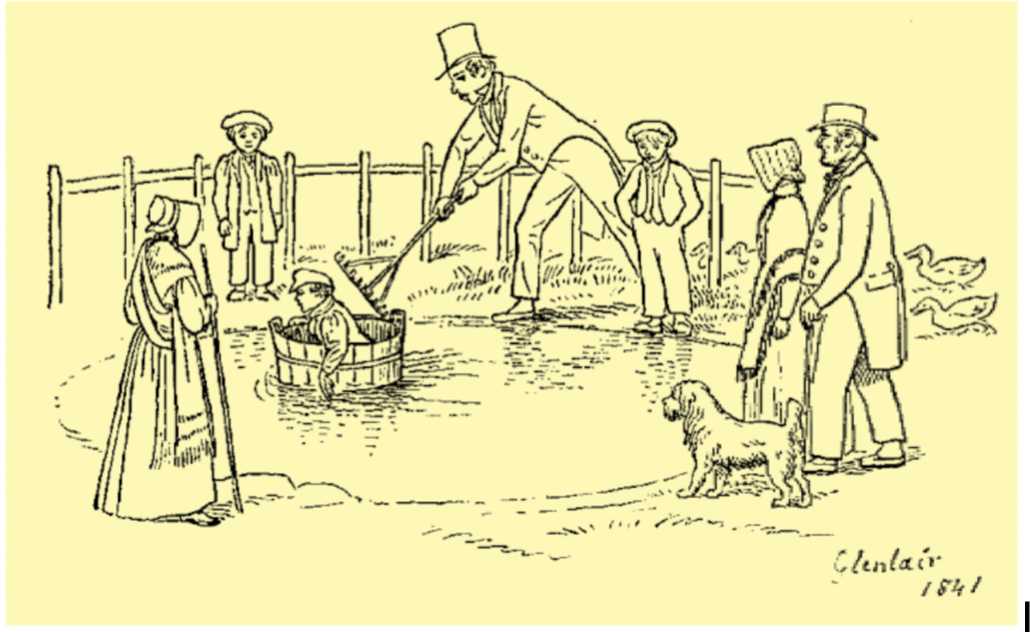
Jemima is the girl with the pole, and the other onlookers are his father, her mom, Toby the dog, and two young neighbors (Campbell, 2020)
Jemima’s biography, adorned with her exquisite paintings, is a mine of information in the Social Sciences. I highly recommend you read the book, to find out about the historical events she witnessed, her adventurous travels, the notable people she met, and the detailed progression of her successful career. I will mainly highlight her inherited traits shared with her cousin James, and will touch upon her life circumstances that have likely affected him.
Their noble origins and common misfortune
Jemima’s mother Isabella (Clerk) Wedderburn was the sister of John Clerk, the father of James, who later added the name Maxwell to their family name. In the Clerk family tree below [Forfar, 1991], both Jemima and James are listed as the seventh generation of the most notable members of their lineage, known for their talents and originality in a variety of fields.
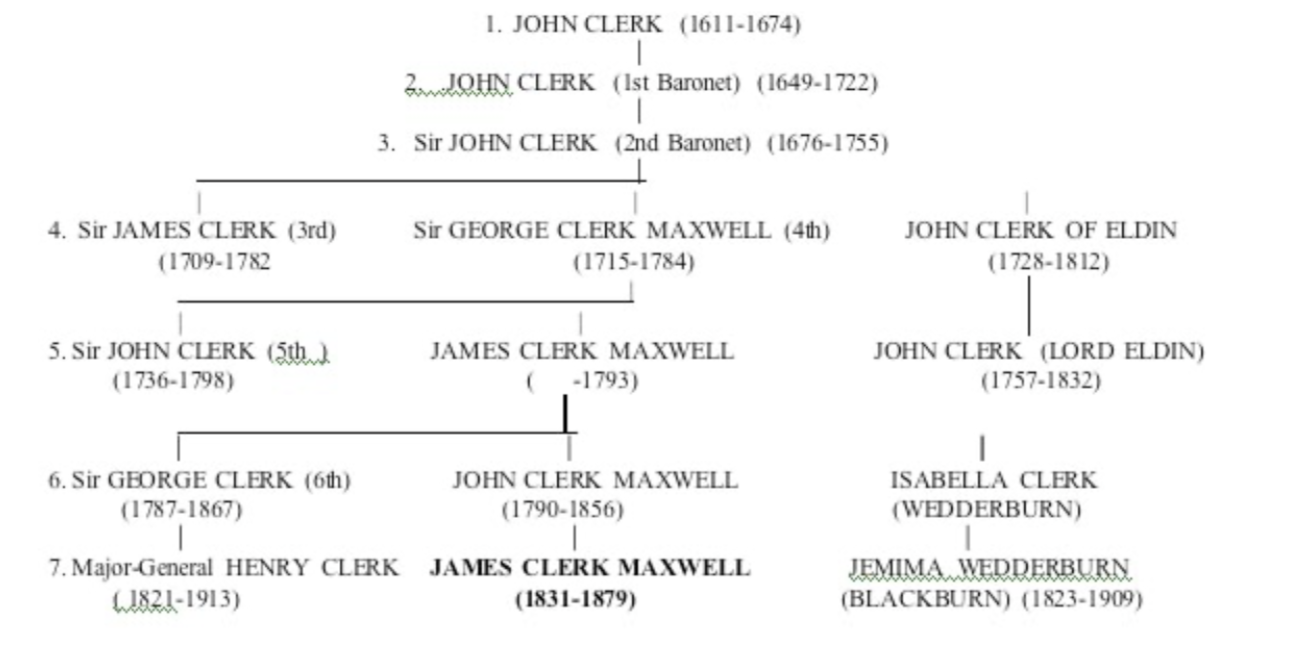
Each cousin benefitted from the other parent’s distinguished lineage as well, the Wedderburns (Jemima’s father) and Cays (James’ mother). The extensive libraries in their homes, probably collected by their progenitors over a couple centuries, was a source of endless pleasure for James in particular.
Misfortune however struck them both early in life. Jemima’s father died before she was born, and she always had a longing for him, as expressed in her memoirs. Maxwell was perhaps more fortunate to have known his mother until he was eight years old, although her death too was a big loss. The effects of an absent parent during their tender years has undoubtedly influenced them both, in ways we will never fully know. It must also have created an unspoken bond between them.
Their ingenious minds
A doctor discovered Jemima’s artistic talent, when he treated her during a prolonged illness in early childhood. He ordered she would drop all other studies and only draw for amusement, to endure the days confined indoors. This started a lifelong successful career, and one hardly saw her without a pen or brush at hand.
She especially loved painting animals whose anatomy fascinated her. She dissected dead mice to study how their muscles moved, and received private lessons on the anatomy of the horse by a college professor.
During her visits to notable relatives, she met famous artists such as Landseer, Millais and Ruskin, with whom she remained on friendly terms. Throughout her entire life, Jemima moved freely among the aristocracy and rubbed shoulders with members of the royal family, who requested paintings from her.
She illustrated 27 books, painted the nativity window of a cathedral in Glasgow, and published several books including “Illustrations from Scripture by an Animal Painter” and “Birds Drawn from Nature”
To her merit indeed, Jemima received the titles of naturalist and ornithologist. Fairly says this about her on page 54,
“Her work was not purely illustrative. She adhered to the Pre-Raphaelite principle of “truth to nature” but added to this a firm belief in scientific accuracy and precision” ”
Once, her drawing of “Young Cuckoo brutally ejecting a young Meadow Pipit from the nest, settled a dispute among a group of scientists about Darwin’s Origin of Species chapter on “Instincts.” The latter had concluded that the Meadow Pipit’s own mother had ejected it accidentally while making room for the young cuckoo. This information had to be corrected thanks to Jemima’s careful observations.
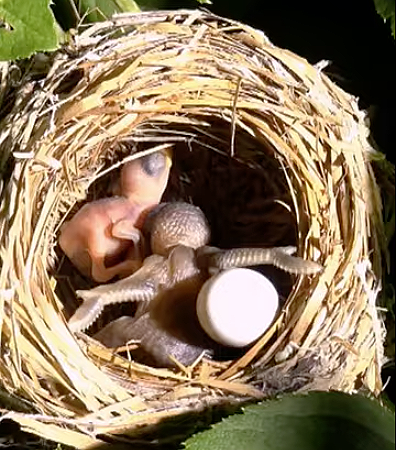
Watch the dramatic scene of a young cuckoo ejecting a Meadow pipit and an egg
Jemima’s progress as a naturalist artist began with a gift that bloomed into fruition after much perseverance and with the guidance of skilled painters. We witness a similar pattern in Maxwell who was mentored early by other scientists; but it was his exceptional talent and dedication to his work that won the respect of the world. To his credit, Jemima’s husband Hugh Blackburn, a Mathematics professor at the University of Glasgow, also introduced him to William Thompson, known as Lord Kelvin. You will get more acquainted with Maxwell’s accomplishment in the upcoming blogs.
“Influence could get me inside the door, but my productivity and the quality of my work were the real tests.”
Their compassionate characters
According to Fairley, Jemima and her husband were always looking out for the welfare of the less fortunate. Here are a few examples.
For many years, Jemima kept a store on their estate in Roshven to sell groceries to their crofters at wholesale prices. She was also known to care for their sick, in their own homes. When the Blackburns improved their estate, they modernised the houses of their tenants, and built a new farm and mill for them.
In 1881, a hurricane devastated the nearby coast and the livelihood of many families, who relied on fishing, was threatened. Jemima provided boats to all the fishermen along twenty miles of the coast. Interestingly, she funded this donation from her own earnings with her pencil.
In 1882, when the crofters of the West Highlands began to revolt against their landlords who were asking them for high rents and evicted their tenants to use the land for profitable purposes, the Roshven estate remained peaceful. The Blackburns, better than an average landowner, were esteemed by their crofters.
Jemima went to the great extent of hiring teachers for her servants' children, some of whom have done well in life. The gracious manner she treated her servants is evident in this quote:
“You don’t know, Mam, what servants are; you only have us and we are at home, only more comfortable.”
Jemima cared for those less fortunate, as did John Maxwell and his son James. In her memoirs, Jemima recounts her visits to Glenlair and her admiration for her uncle John. She describes him as the most sensible and kind man she ever knew. When I wrote the stories about James Maxwell in the Light Module , I portrayed both father and son as kind and compassionate towards all, regardless of their class in society.
Conclusion
Both Jemima and James benefitted from their noble lineage that afforded them the best education a boy or a girl of their period could receive. They became leaders in their respective fields, due to their unique talents and diligence. They were not puffed up by their abilities and acquaintances; but instead looked after the less fortunate. Thus following God’s commandments to be generous towards the poor.
““For you always have the poor with you, and whenever you want, you can do good for them. But you will not always have me.” ”
Jemima however didn’t appear to be a woman of any faith, and she even admitted in her memoirs to being agnostic as a child. She however respected the clergy and the religion of others. Interestingly, Railey describes her husband Hugh as someone with a quiet and sincere religious faith, which created a special bond between him and the young James. As I continue writing about James Maxwell, you will see how his faith in God deepened throughout adulthood.
Overall, Jemima left a wonderful legacy in the world of Arts and Society. Her life made me more aware of the influences on Maxwell as he was making his own decisions and looking at the world with his own lens.
How about you, what lens have you been using as you navigate through life? Has it changed over the years?
References:
Campbell, Lewis; Garnett, William. The Life of James Clerk Maxwell (Illustrated) (p. 30). (Function). Kindle Edition.
Forfar D. O., “The Clerks Maxwell's Heritage: the Ancestral Origins of his Genius”, 1991, https://victorianweb.org/science/maxwell/forfar2.html